There really were a lot of packets still waiting to be sown from last year when sorting through my seed tin early this week. Needless to say, this didn’t deter me in spending several evenings scrolling through pages of gorgeous plants on line, making notes and topping up on a rather fine new selection for this year.


Every year, once my seeds are sown, grown and planted out, I spend my spare time sitting at the garden table or walking very slowly around my very small garden, just taking in the beauty of it all.
It is an entirely immersive experience just watching and listening into the sounds of visiting wildlife and ornamental grasses moving in the breeze. Hours can disappear very easily – and they do.


If I want to be critical, there were times last year when the garden was too static in its flower colour. This was mainly due to choosing perennials and annuals which all had long flowering seasons. Additionally they were planted in large groups, which didn’t leave much space for other flowering plants, to join them in the mix.
Certain cultivars of Persicaria are a really good example of this. As flowers they possess great colour, which literally last and last and last ! If my garden was larger, they could easily be combined with other plants. However my garden borders are not long – they come in at just under 10 metres , so at times they did feel a little heavy on the pink or white. They are also very good at sending out their rhizomatous roots to spread through the limited planting space.
Please note they won’t be dug up entirely this year and disappear, as they are such beautiful flowers. I just need to use them in a different way.

Persicaria alba 
Persicaria amplexicaulis Orange Field
This year is going to be different, as attention will be given to my chosen plants flowering times, ultimate height and spread.
The latter is really important, as many of the root systems of my favourite plants do move through borders, squashing out other plants in their way. Which as I have already mentioned isn’t the best thing when your growing area is small .
This year will see the continued development of using plants in a layered effect at home. The first image below was taken at Trentham gardens and visually explains this ” layered effect ” . You can see several different plants in the grouping, all of which have different flowering times . Planting this way will provide a more continuous flowering time over the seasons. As one plant is flowering, another might be sending up a flower shoot, or have a seed head. In effect creating a more diverse and interesting visual experience.

Trentham 
My garden 
Trentham
Through designing and planting in this way , it will enable a continuous turnover of plants, each providing different waves of colour throughout the seasons. With this in mind, my greenhouse already has foxgloves growing on. They will start sending up their flower stems in late spring, and flower in early summer. Later flowering plants- such as Amaranthus or Weld could then replace the foxgloves later in the season.
I love this idea gathering and planning stages. Having a good photographic library is a real help for visualizing my 2021 garden.

Foxgloves 
Amaranthus 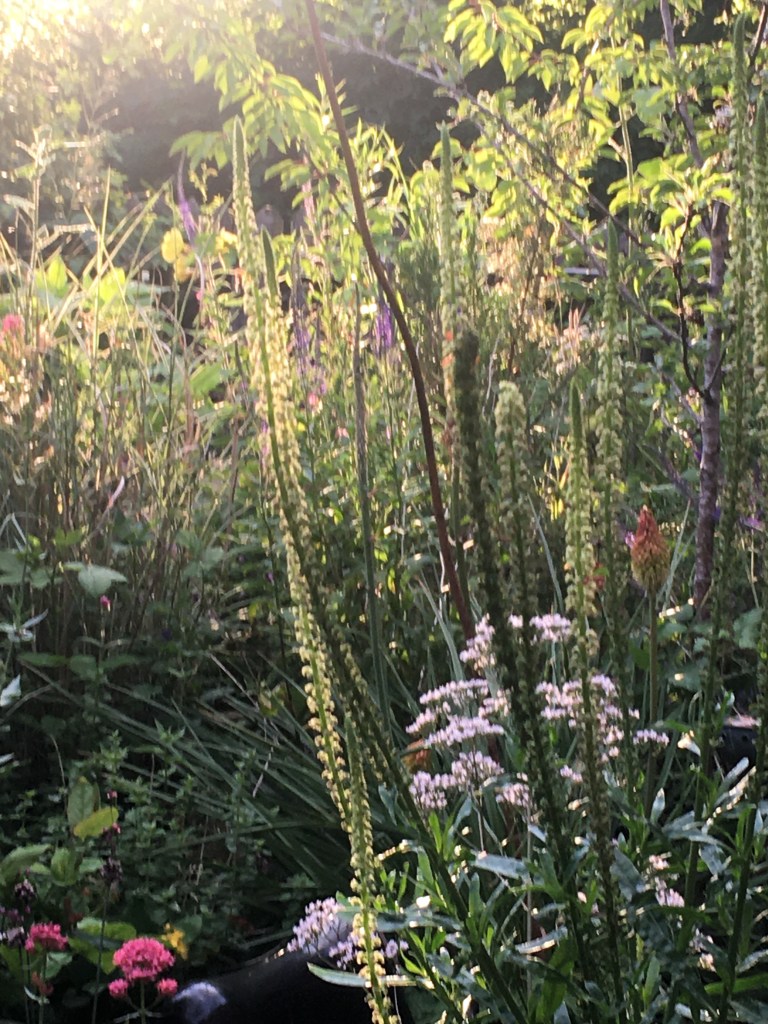
Weld
What I don’ t want to see, is a vast array of different flower colours all at the same time, I would like the garden to be gentle in spring, so pale lilac, primrose yellow, pale pink, and as the season moves into summer, I would like to increase their intensity to red, orange and yellow. Amaranthus, Tithonia rotundifolia and Rudbeckia maxima will hopefully help out here. I am also imagining electric blue and purple bursting through as occasional vertical elements – Salvias and Verbena bonariensis might help out here.
I do have a vague vision of how my garden might turn out this year. I wonder what this year will bring ? As you can see it is a very large selection of containers, which do tend to move on an annual basis, and this is how it started off last year.


This year, the seating area will be entirely surrounded by all my containerised trees and shrubs, to create a dappled shade woodland effect, and moving from this woodland edge will be swathes of low and tall ornamental grasses, with my chosen perennials and annuals emerging through them .
And the reason for this, I am never happier when I am surrounded by woodland, which provides views out to surrounding fields of arable crops or wildflower meadows moving in the breeze. I hope to create a cultivated version of this, using my favourite flowers.


My garden made me really happy last year, however I have new ideas, and as my garden is a perpetual design, it is time to move it on again. One way to improve your knowledge is to study, and I am presently on a course with www.gardenmasterclass.org . Over the last couple of years, I have attended several of their excellent courses including Vlinderhof , Trentham and An Irish adventure
This present course is entitled “Naturalistic Planting” and is covering the subject matter of plant ecology and naturalistic planting. The lecturers – Nigel Dunnett and Noel Kingsbury are world class leaders in ecology and design. It is a fascinating course.
January’ s lecture considering the layering of plants in a naturalistic design, these are some of my basic notes, and to put it very simply there are four key areas to consider.
- A structural framework, which creates the structural framework of the design – trees, shrubs and ornamental grasses
- Perennials – plants that have no structural capacity, but their presence provides a real burst of visual character – so this could include Echinacea and Asters,
- Ground cover plants, which are low growing plants that fill space and create a visual impression early on in the year , being shade tolerant is important, as they need to be able to survive shade cast on them as later flowering perennials grow up. Geranium sylvaticum would be an example of this.
- Filler plants , which are really important at the beginning of a newly planted scheme, so they could be short lived perennials and annuals. My garden has a reasonable amount of Verbena bonariensis, which is an example of this.
I now need to think carefully about all the existing plants in my garden, and put them into each of these four categories, before I start with a design and planting plan. These four categories will guide me in creating my garden this year.
Over the last ten years, I have become particularly interested in using annuals and dahlias within my garden. I am really interested in seeing if, and how I can include them to create my own naturalistic inspired garden.
So, as well as studying, and ordering seeds and coming up with a new garden design, what else is happening in my garden ?
I decided last autumn to attempt to make my greenhouse a productive all year round growing space. With this is mind, annuals and salad crops were sown in late August, and I am really happy with the results. Seedlings now sit under fleece for the majority of the time, and there continues to be small amounts of winter salad.


Birds have been flocking in to the garden to check out the available seed both from existing plants in the garden and from commercially bought seed. Gold finches headed to the teasels. Sparrows, lesser spotted woodpeckers, nut hatch, bluetits, coaltits, long tail tits and robins (to name but a few ) head to the commercially bought seed and blackbirds have been demolishing rose hips. I stand and watch for a coffee cup’s worth every morning before heading out to work. It is shortly to be the RSPB great bird count, and I will definitely be participating. www.rspb.org.uk

I hope you have enjoyed this fortnights round up. My seeds should have arrived in time for the next blog, and I will share my choice, my seed sowing plan . So, why not join me, on my 2021 garden design adventure. Any queries, please send me a message through the contact page.
Sally x

 Sally Wicks